Engineering Standard · Manufacturing Control · Field Proven
Tru-Trac designs, manufactures, specifies, installs and supports conveyor components to one disciplined standard. The product is only part of the value — the rest is the control behind it: application knowledge, manufacturing discipline, correct specification, documented commissioning and field feedback from demanding conveyors. That discipline is what lowers the cost of conveyor instability.
02 / Specification to duty
Two conveyors can share a belt width and still need different specifications. The operating condition decides the answer: material, loading, speed, belt tension, transfer geometry, moisture, abrasion, maintenance access, duty cycle and failure history. A component that's correct on paper still fails if it's wrong for the duty.
Public-preview inputs
- Belt width
- Belt speed
- Material handled
- Loading condition
- Carryback pattern
- Installation access
- Failure history
The full Operating Envelope Checklist — a gated technical resource — adds the remaining engineering inputs used in formal specification.
Download the Operating Envelope ChecklistExample — Apex Tracker operating envelope (TT-AT-S2)
- Belt width
- 600–2400 mm
- Belt speed
- 0.5–5.0 m/s (max 6.0)
- Self-centring
- ≤ 20 s @ 4 m/s
- Sensing roller
- HDPE abrasion-grade
03 / In-house manufacturing
Conveyor performance depends on repeatability, so product development, manufacturing control, quality discipline and field feedback sit inside one operating system. That lets Tru-Trac hold product consistency, adapt designs for specific duties, support partners with technical confidence, and standardise a site without losing the engineering standard behind the product.
The controlled chain
- 01
Design
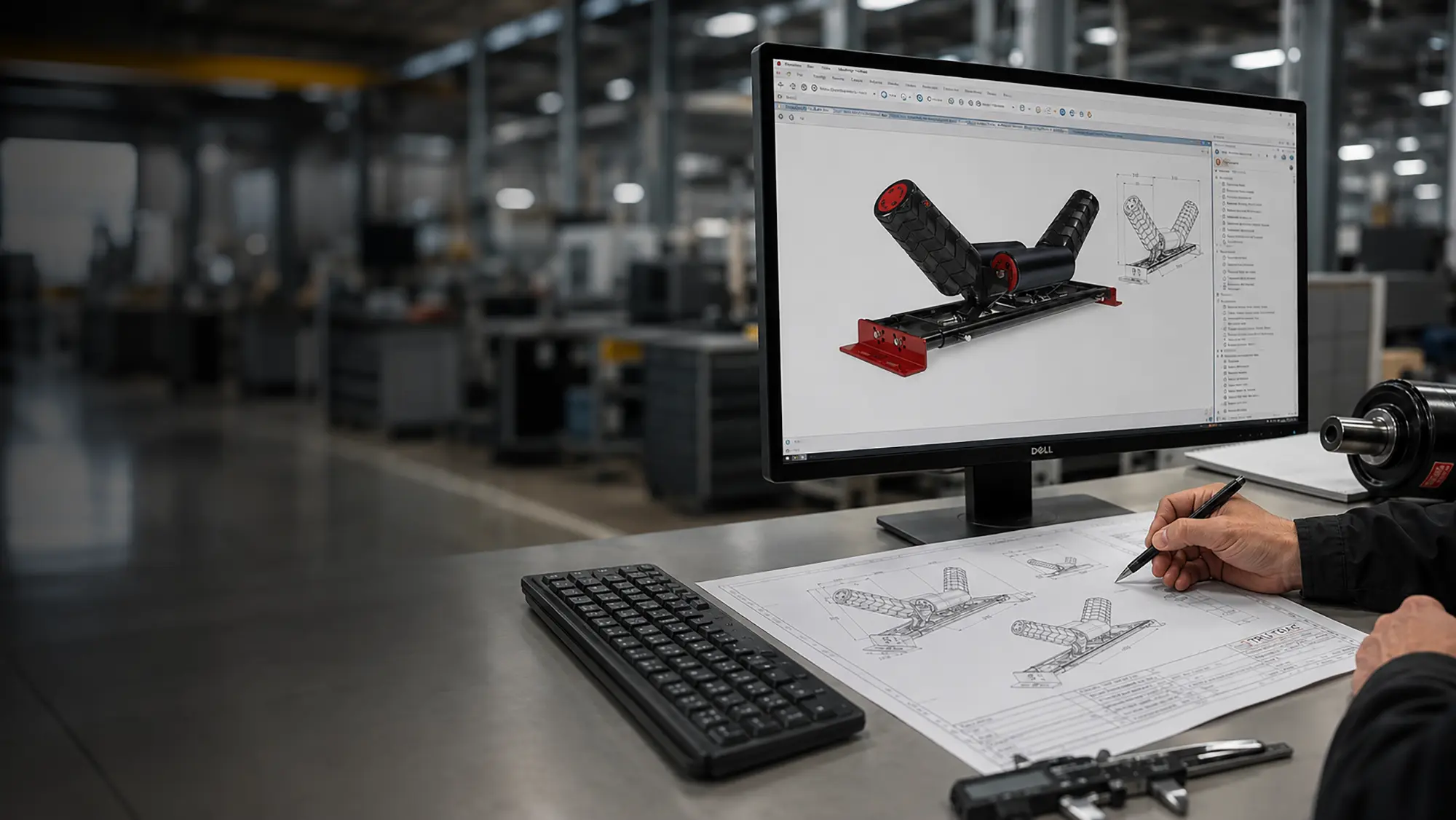
Engineering review, product drawings, CAD, application notes. Shows product intent before manufacture.
- 02
Material Control
Rubber, lagging, steel and component preparation. Input control, not commodity assembly.
- 03
Fabrication
Cutting, machining, welding and preparation. OEM production capability.
- 04
Assembly
Build, fitment checks, adjustment points, component integration. Repeatable build discipline.
- 05
QA
Inspection, measurement, sign-off and documentation. Quality as a control system.
- 06
Dispatch
Packing, labelling and international supply readiness.
- 07
Field Feedback
Assessment reports, case outcomes, distributor feedback and engineering review.
Field feedback closes the loop: every site assessment, installation, failure investigation and performance review feeds back into product design and selection logic — the range has grown because customers kept bringing the next failure mode back to the same engineering team.
04 / Installation & commissioning discipline
Tru-Trac's engineering standard does not stop at manufacture. Correct installation, positioning, commissioning and baseline checking are critical to field performance. Installation support, supervision, training and commissioning sign-off form part of the Tru-Trac operating model where required by application, project or customer need.
05 / Quality & certifications
Certifications matter only when backed by internal discipline — controlled processes, documented checks, responsible sign-off and product evidence that stands up to serious procurement and engineering review. Public proof is shown with accurate scope; detailed procedures, certificate PDFs and test data stay appropriately internal or gated.
What you can verify
- 01
OEM manufacturing capability
Factory imagery, capability cards, product development and manufacturing control narrative.
- 02
Current certifications
Verified certification cards with scope, issuing body, date and expiry controlled in CMS.
- 03
Product documentation
Datasheets, brochures, selection guides and installation resources managed through Technical Library.
- 04
Case evidence
Anonymised or approved case outcomes linked to relevant product families and failure modes.
- 05
Technical support process
Clear routes for assessment, project specification, product support and engineering escalation.
- 06
Global supply history
Footprint, distributor routing, international applications and regional support pathways.
Whether you are specifying equipment for a new project, standardising a site, solving a recurring belt problem or evaluating Tru-Trac as a regional partner, the right starting point is the same: understand the operating condition, then specify the solution.