Knowledge · Comparison guide · Belt cleaning
Primary vs secondary belt scrapers.
What each one does, where it installs, and why most conveyors need both in sequence.
Direct answer
Primary vs secondary scrapers — the practical difference.
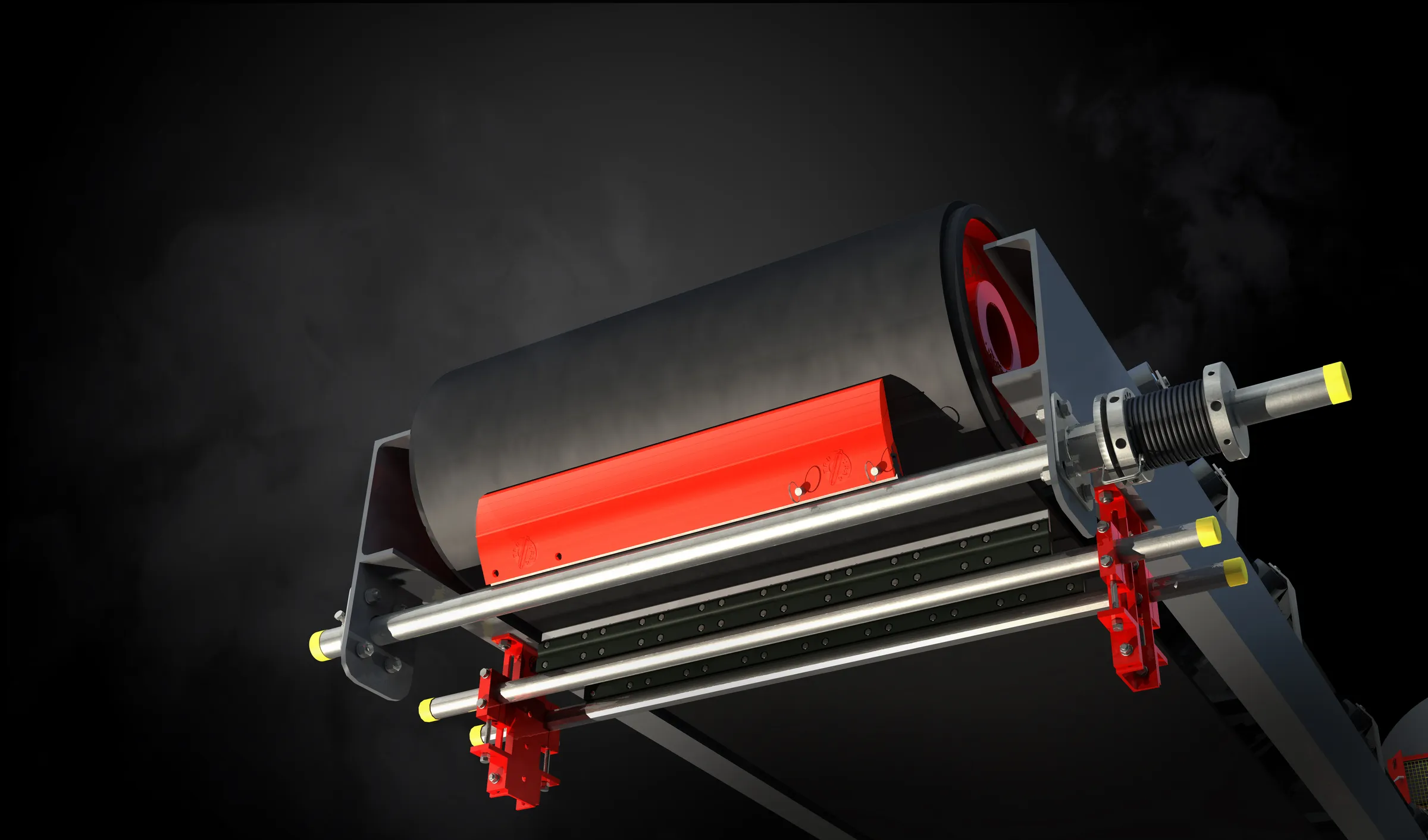
A primary scraper installs against the belt at the head pulley face, where the belt is curved and the rubber is fully supported. It removes the bulk of the discharged material immediately after the load leaves the belt. A secondary scraper installs below the discharge trajectory on the straight return path, where it addresses the fine residue layer that the primary scraper leaves behind. The two are not interchangeable: primary scrapers handle volume; secondary scrapers handle finish. Most conveyors carrying material with measurable carryback need both in sequence — primary first, secondary second — with a return-side plough at the tail if spillage reaches it.
01 / Side-by-side
Primary vs secondary, at a glance.
Quick comparison of the role, position and cleaning profile each scraper covers.
02 / Primary role
What the primary scraper does.
01
Bulk material removal
The primary scraper meets the belt at the head pulley face and removes the dominant share of material that didn't discharge into the chute. It is the first cleaning stage.
02
Blade contact pressure
Because the belt is fully supported on the pulley, the primary scraper can apply meaningful contact pressure without belt deflection. This is where most cleaning energy is delivered.
03
Material chemistry handling
Primary blades come in different chemistries — urethane for general bulk handling, tungsten-tipped for abrasive or hard materials, specialist blades for sticky / hot / chemically reactive applications.
04
Tensioning strategy
Primary scrapers are typically tensioned mechanically or hydraulically to maintain blade-to-belt contact pressure as the blade wears.
03 / Secondary role
What the secondary scraper does.
01
Fine residue removal
Secondary scrapers address the thin material layer that a primary scraper doesn't reach — moisture-bound fines, sticky residue, light coating on the belt rubber.
02
Belt-unsupported position
Mounted on the straight return path past the discharge trajectory. Because the belt is unsupported at this position, blade contact pressure is lower and more carefully controlled.
03
Different blade geometry
Secondary blades typically use a different rake angle and finer blade edge than primaries — designed for finish, not for bulk.
04
Return-side stability contribution
By reducing carryback past the discharge zone, secondary scrapers reduce the rate at which return idlers and the tail pulley become contaminated.
04 / Combined systems
When you need both, and how they work together.
Most bulk-handling conveyors carrying material with measurable carryback benefit from a combined system. The two stages handle different cleaning profiles and together cover the whole range.
A
Primary handles volume
On a wet, sticky or fines-heavy material, the primary catches the bulk. Without it, the secondary is overwhelmed in hours and provides no useful cleaning.
B
Secondary handles finish
Even after a well-tensioned primary, a thin residue layer remains on the belt. The secondary addresses that layer before it becomes return-side spillage.
C
Return-side plough closes the loop
Any spillage or tramp that escapes both scrapers and lands on the return belt is diverted off by the plough before reaching the tail pulley.
D
Total carryback is the product of the three stages
Each stage reduces what remains. Skipping a stage doesn't halve the cleaning — it usually concentrates failure at the next stage.
05 / Selection factors
How to choose primary, secondary or both.
Selection follows the conveyor and the material — not the catalogue. These are the factors Tru-Trac uses to size and stage the cleaning system.
Material moisture and stickiness
Wet / sticky materials usually need both primary and secondary, and may need specialist blades.
Belt speed
Faster belts give the primary less dwell time at the pulley face; secondary stage becomes more important.
Belt width
Wider belts require more blade segments and may justify multi-stage primary configurations.
Pulley diameter
Smaller pulleys give the primary a tighter working geometry and may favour different blade designs.
Carryback tolerance
Operations with low housekeeping tolerance (food, pharma, environmental sensitivity) almost always need both stages plus a plough.
Maintenance access
If blade-change access is constrained, longer-life blade materials and self-tensioning systems become priorities — not extra stages.
Related
Problem guide
What causes conveyor carryback?
Material factors and belt conditions that drive carryback.
Read
Technical guide
Belt scraper selection guide
How to choose a scraper matched to the conveyor.
Read
Product
Belt Cleaners & Scrapers
Primary, secondary, ploughs and specialist cleaning.
Read
Zone page
Belt cleaning zone
Where cleaners sit in the five-zone Tru-Trac System.
Read
Take action
Get scraper advice
Site-led engineering review.
Read
Frequently asked
Practical questions, answered directly.
01Do I need both?
Most conveyors carrying material with measurable carryback need both a primary and a secondary scraper. The primary handles volume at the head pulley face; the secondary handles the fine residue layer past discharge. They cover different cleaning profiles — running one without the other usually concentrates failure at the missing stage. Operations carrying very dry, free-flowing material with low carryback tolerance MAY get acceptable cleaning with a primary alone; a Tru-Trac assessment confirms which configuration matches the duty.02Where are they installed?
Primary scrapers install against the belt at the head pulley face, where the belt curves around the pulley and is fully supported. This is where contact pressure can be applied without belt deflection. Secondary scrapers install on the straight return path past the discharge trajectory, where the belt is unsupported and the residue layer is accessible. A return-side plough installs near the approach to the tail pulley to catch any material that reaches it.03Can a secondary replace a primary?
No. A secondary scraper is not designed for bulk material removal — its blade geometry and contact pressure are tuned for fine-residue cleaning on an unsupported belt. Using a secondary in the primary position overwhelms the blade in hours, provides no useful cleaning, and concentrates carryback downstream. The two are sequential, not interchangeable.

Tell us the material, the belt and the carryback.
We'll specify the primary / secondary / plough configuration matched to the duty.