Knowledge · Selection guide · Belt tracking
Conveyor belt tracker selection guide.
How to choose the right tracker for the conveyor — belt position, width, speed, load conditions, installation point and operating envelope.
Direct answer
How to select a conveyor belt tracker.
The right belt tracker is matched to the conveyor's operating envelope, not picked from a catalogue. Six inputs decide the specification: belt position (carry side vs return side), belt width, belt speed, load conditions (continuous, intermittent, severe-duty), the installation point on the conveyor where lateral correction is required, and the operating limitations of the structure (clearance, access, mounting). A tracker that fits the belt width but is undersized for the speed-load combination will wear out fast; a tracker positioned at the wrong point on the belt path will not catch drift before it becomes contact. Tracker selection is therefore a function of the conveyor, not just the belt.
01 / Position
Carry side vs return side.
The first selection decision is the belt position. The two tracker families address different failure modes at different points on the belt path.
02 / Specification inputs
The six inputs that drive selection.
Each input below is asked during a Tru-Trac belt-tracking assessment. The output is a specification matched to the duty.
| Input | Range | What it controls |
|---|---|---|
| Belt position | Carry / Return | Selects the tracker family and mounting frame geometry. |
| Belt width | Standardised, mm | Drives roller length, frame size and the lateral travel envelope. |
| Belt speed | m/s | Controls dwell time at the tracker; faster belts may need a heavier-duty tier. |
| Load condition | Continuous / Intermittent / Severe | Drives the duty tier (STD / HD / XHD / EXHD). |
| Installation point | Position on belt path | Decides where lateral correction is applied — too far upstream loses correction window; too far downstream is too late. |
| Operating envelope | Clearance / access / mounting | Limits which tracker body and tensioning system can be retrofitted. |
03 / Duty tiers
Duty tier matches the conveyor envelope.
Duty tier is the dominant cost-vs-life driver. Choose the lowest tier that fully covers the operating envelope; over-specification adds cost without benefit, under-specification wears out fast.
STD
Standard duty
Conveyor speeds and load conditions inside a typical bulk-handling envelope. Continuous operation; standard belt widths.
HD
Heavy duty
Higher belt speeds, heavier loads, longer continuous runtime. Mining and primary bulk-handling applications.
XHD
Extra heavy duty
Severe-duty applications — high tonnage, severe abrasion, demanding environments. Specified case-by-case.
EXHD
Extreme heavy duty
Defeat-prior-solutions applications — wide belts, high speed, severe operating envelope. Engineering-confirmed specification.
04 / Installation point
Where to install, and where not to.
Tracker position matters as much as tracker selection. A correctly specified tracker mounted in the wrong place will not hold the belt true.
A
Far enough upstream
Mount the tracker far enough upstream of the protected point (head pulley, tail pulley) that there's a meaningful correction window. Too close and the tracker has no time to respond.
B
On a stable carry / return section
Avoid mounting on a section of belt that is itself under transient loading — vertical curves, transitions, near skirting. The tracker needs a stable belt to respond to.
C
Clear of contamination sources
Don't mount return-side trackers immediately downstream of a known carryback source; clean the cause first, then specify the tracker position.
D
Accessible for maintenance
Position must allow inspection, idler rotation, and replacement without structural disassembly. If access requires shutdown, total cost of ownership dominates.
05 / Limitations
What a tracker will not do.
Three things to know before specifying. A tracker is a precision correction device, not a substitute for upstream engineering.
Will not correct off-centre loading
Loading-zone behaviour must be addressed at the loading zone. A tracker downstream will fight the loading, not correct it.
Will not correct structural misalignment
Frame, idler-set or pulley misalignment must be confirmed before specifying. The tracker cannot square a frame.
Will not correct a bad splice
An out-of-square splice causes recurring lateral pull on every belt revolution. The tracker will fight the splice and wear prematurely.
Related
Product
Belt Tracking Systems
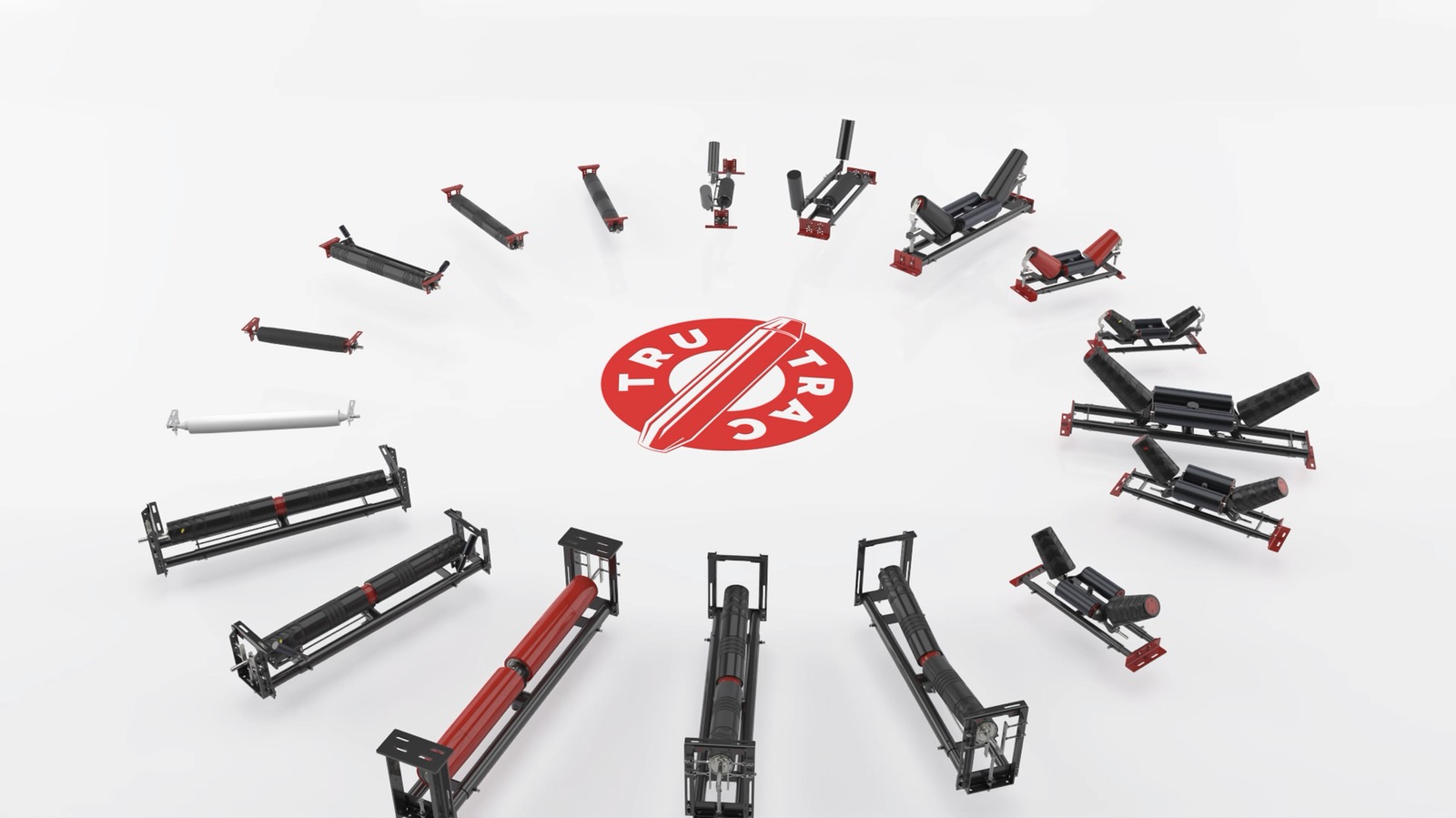
The Tru-Trac tracker range — Apex, carry-side, return-side and specialist.
Read
Product
Apex Tracker Series
Flagship Tru-Trac tracker — engineered for severe-duty conveyors.
Read
Take action
Tracker Selector
Two-minute selector tool — narrows by belt width, speed and duty.
Read
Problem guide
What causes mistracking?
Understand the cause before specifying the tracker.
Read
Problem guide
How to fix mistracking
The six-step inspection sequence.
Read
Frequently asked
Practical questions, answered directly.
01Which tracker do I need?
The right tracker is matched to belt position (carry vs return), belt width, belt speed, load condition (continuous / intermittent / severe-duty), the installation point on the conveyor, and the operating envelope (clearance, access). Use the Tru-Trac Tracker Selector for a quick first pass, or request an assessment for an engineering specification.02Carry side or return side?
Carry-side trackers stabilise the loaded belt before the head pulley, addressing drift caused by load-zone behaviour and carry-side idler condition. Return-side trackers stabilise the empty belt before the tail pulley, addressing drift caused by carryback contamination and return-side idler wear. Most conveyors with persistent mistracking require correction in both zones.03Can I retrofit a tracker?
Yes, in most cases. Retrofit specification depends on available clearance around the conveyor structure, mounting frame access, and whether the upstream causes have been addressed. A site assessment confirms which tracker body and tensioning system fit the structure as built.

Specify against the conveyor, not the catalogue.
Send us the belt width, speed, load profile and a photo of the mounting position. We'll come back with the right tracker spec.